Minimally Invasive Scoliosis Surgery
Benefits of Minimally Invasive Scoliosis Surgery
Because it is a far less invasive procedure, a series of sequential dilators to dilate the muscles without having to cut into them. The major advantages of this type of procedure are:
What is Scoliosis?
Scoliosis is a spinal condition that generally develops during a patient’s youth, around the age of puberty. It is characterized as a sideways curvature of the spine. As it effects young people, if left untreated the curve will usually worsen as the patient grows in age. While mild cases are common, and patients can live a highly functional life, severe cases are completely debilitating and lead to difficulty taking on normal everyday tasks. Commonly there are few symptoms aside from some pain and the curve of the spine, however, over time, scoliosis can cause a number of other deformities to occur in the spine.
For more severe cases of scoliosis, spinal fusion surgery is necessary. However, because spinal fusion effectively stops the growth cycle, by fusing the patient’s growth plates it is advised that patients seek non-invasive means of delaying surgery, such as the use of spinal growing rods, braces and physical therapy. Once the patient reaches its maximum growth, a few different types of surgery may be performed.
Minimally Invasive Scoliosis Surgery
Minimally invasive scoliosis surgery is an endoscopic procedure performed through a small incision rather than one long incision. So that there is less scarring, and faster healing time. In this approach a thin telescope-like instrument with a tiny video camera called an endoscope is inserted through one of the incisions, providing the surgeon with real-time, internal imaging of the patient’s body. These images and intraoperative X-ray images act as a guide for the surgeon to perform the surgery.
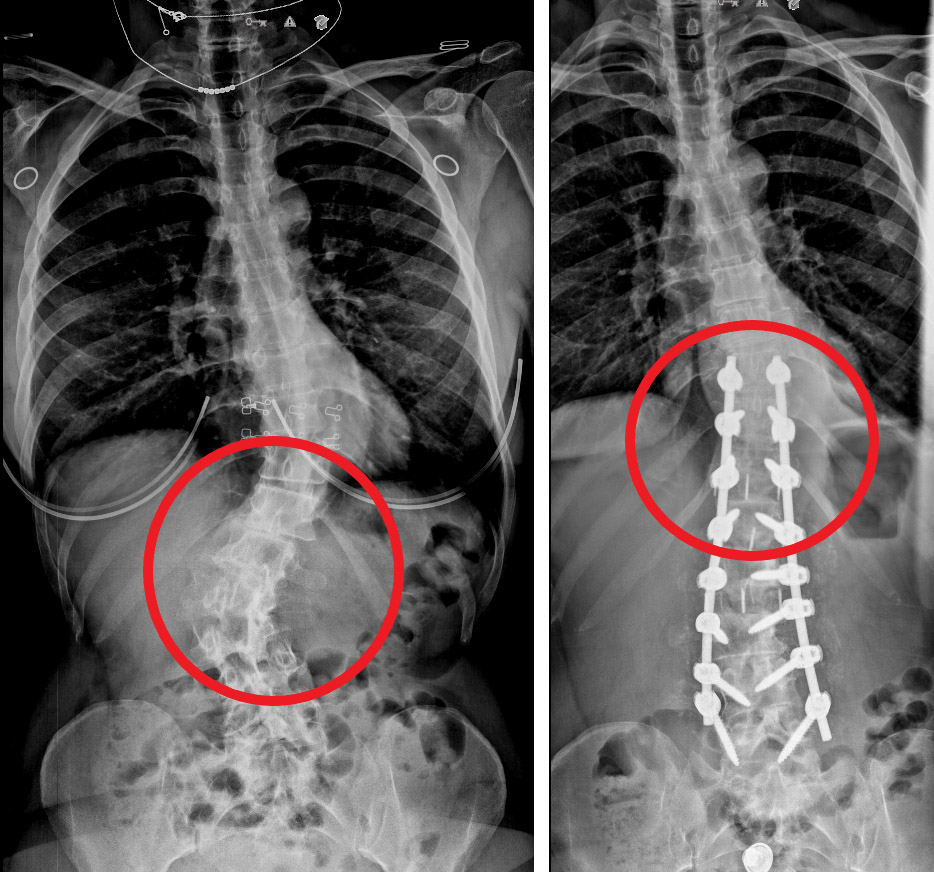
Depending on your specific corrective needs, a number of solutions can be used to fix the spine’s curve. When certain discs are removed the spine can be moved more easily and straightened out before fusion. For most patients, spinal instrumentation is used to correct the curve overtime and prevent it from worsening, while the bones take time to fuse. Common spinal instruments are:
- Metal Rods (growing rods, straightening rods, etc.)
- Hooks
- Metal Plates
- Screws
- Spacers
The spinal bones can take anywhere from 6-12 weeks for the bones to fully fuse, however patients will notice some immediate reduction in the spinal curve. It is usually prescribed that patients wear a brace to hold the spine in place and aid in the straightening of the curve.
Dr. Varma will provide patients with after care information both during your consultation and after the procedure. These procedures are often different depending upon the patient’s specific needs. To schedule your appointment with Dr. Vikas Varma, and for more information on scoliosis treatment or fusion surgery, contact us today.